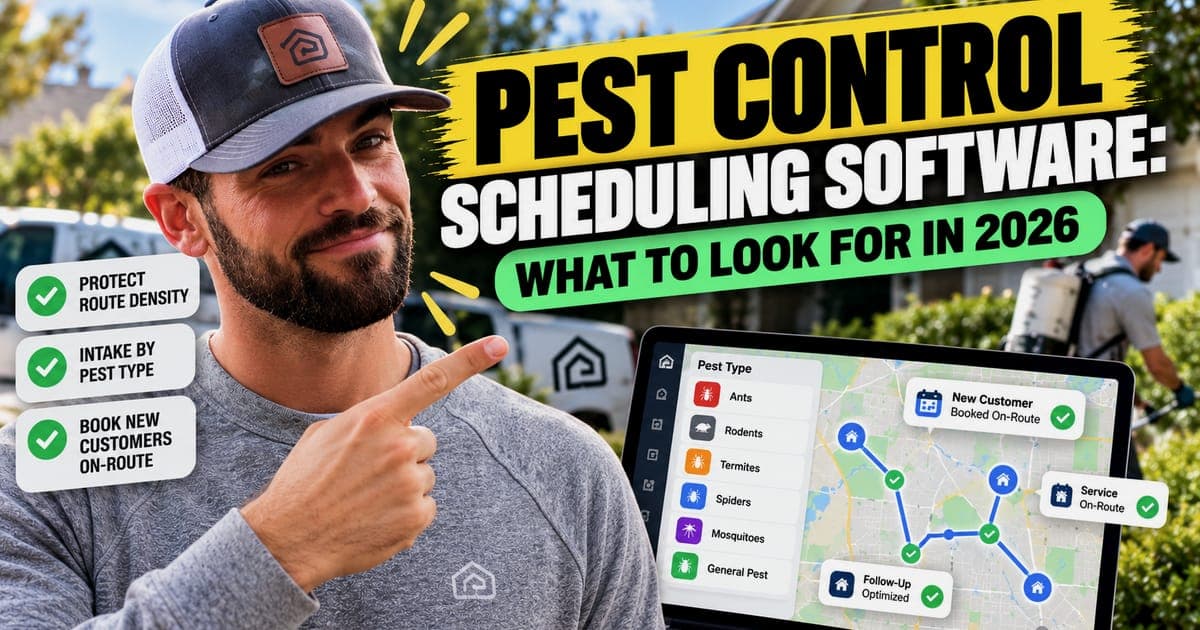
Pest Control Scheduling Software: Win the Route at the First Booking
Pest control scheduling software should protect route density at the first booking. What to look for, intake by pest type, and how to book new customers on-route.
Industry trends, scheduling strategies, and insights to help your field service business thrive.
Featured

Pest control scheduling software should protect route density at the first booking. What to look for, intake by pest type, and how to book new customers on-route.
Recent posts

Pest control scheduling software should protect route density at the first booking. What to look for, intake by pest type, and how to book new customers on-route.

Speed to lead is the time between a customer reaching out and your business having a real two-way conversation. Here are the response-time benchmarks by channel for home service businesses, how to measure your real number, and the 8 fixes that move booked jobs.

Multi-location and franchise scheduling breaks differently than single-site booking. What breaks first, what to look for, and how to fix it without adding headcount.

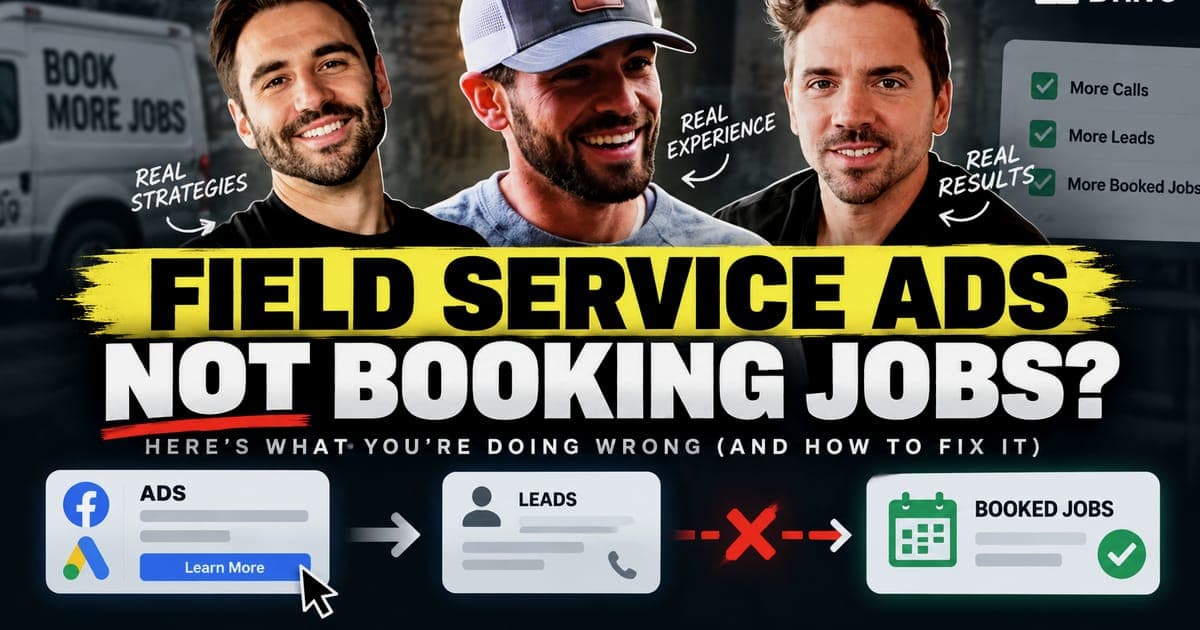
You're spending money on Google Ads, maybe LSAs, maybe even Facebook. The clicks are coming in. But the jobs? Not so much. Here's the thing most field service companies get wrong about digital marketing.

Homeowners aren't Googling the way they used to. They're opening ChatGPT, describing a problem, and asking for a recommendation. Here's what determines whether your business shows up in that answer, and five things you can do about it this week.

Jobber publishes real numbers, but the sticker price is not what most teams end up paying. Here's the full breakdown, plan by plan and add-on by add-on, plus the payment processing fees that never show up in the plan price.

Driive CEO Quinn Small sat down with Phlash Consulting to explain why booking tools alone don't fix home service scheduling. Here's the decision layer, and what it means for AI search.

AI receptionist pricing ranges from $25/mo self-serve plans to $3,500/mo enterprise platforms. Here's what actually drives the cost, and why price isn't the question that matters most.

ServiceTitan doesn't publish a rate card anywhere — no plan comparison, no calculator, no self-serve signup. Here's what's actually known about the per-technician cost model, implementation fees, contract terms to ask about, and where a tool like Driive fits relative to it.

New to Driive? This quickstart walks you through configuring the platform from the ground up — inviting users, building teams and service areas, connecting integrations, creating appointment types, publishing booking pages, and turning on DOT for inbound call handling. Follow it in order and you'll have a live, qualified booking system in an afternoon.

Driive booking pages now support direct inline embeds and a smart routing form that sends each visitor to the right appointment type — not just a Book Now button. This quickstart shows first-time users how to build, brand, and publish a booking page, and shows anyone still on the old website widget how to migrate before their booking link breaks.

The gap between "request an estimate" and a real appointment isn't a design problem — it's a qualifying and scheduling problem. Either the system does that work the moment the customer shows up, or someone on your team does it days later. Here's what a booking flow that routes by qualification, availability, service area, and drive time actually looks like.

The AI booking software category has a vocabulary problem. "AI receptionist," "AI booking agent," and "AI scheduling software" get used interchangeably by vendors who mean three different things. Here are 15 terms in plain language, with no vendor spin baked into the definition itself.

Real-time scheduling means live booking across every channel combined with drive-time-aware routing and automated lead qualification. Here's what it looks like in a trades business, why it lifts revenue and utilization, and how to roll it out without disrupting operations.

Driive provisions a dedicated number for Dot, your AI receptionist, and you forward your existing business line to it. Setup takes under five minutes on most phones and VOIP systems. This guide covers every path: mobile carriers, VOIP platforms, desk phones, and landlines, plus how to decide between always-on forwarding and conditional forwarding.

Housecall Pro is worth it for service businesses running three or more technicians with active marketing and a clear lead conversion process. This review breaks down the features that drive results, the real cost after add-ons, the iOS-versus-Android gap, and exactly when the platform pays for itself.

Lead conversion software captures, qualifies, and books inbound inquiries automatically, and for home service businesses every missed call is a missed job. This guide covers the key features, integrations, implementation steps, and best practices that turn inquiries into booked appointments before competitors can respond.

HVAC lead generation runs on two parallel funnels: one for emergency repairs and one for system replacements. Owned leads convert at 35–80%, while shared platform leads convert at just 8–20%. This guide covers how to generate HVAC leads across owned assets, paid channels, maintenance plans, and referrals.

An AI call service answers every inbound call, qualifies leads, and books appointments without a human on the line. For trades businesses, that means fewer missed calls, fewer no-shows, and more booked jobs. Here's how the technology works and how to deploy it well.

Broccoli AI is one of several AI voice-agent platforms for home service businesses, alongside Avoca, Alivo, CHIIRP, and Driive. The right alternative depends on whether your problem is missed calls or calls that get answered but booked badly. Here is how the five options compare.

The best way to get HVAC leads combines Google Local Service Ads, an optimized Google Business Profile, and a lead response system that books calls before your competitors pick up the phone. This guide covers every major channel, the dual funnel model top operators use, and the operational changes that turn more leads into booked jobs.

Booking and dispatching jobs for small teams gets messy when drive time, technician skills, and payment tools don't sync together. This comparison lays out dispatch, customer management, and payment features across Driive, Service Fusion, Kickserv, and Workiz so you can match one to your business needs.

You don't need an agent framework. You need a durable while-loop. A walkthrough of Utah, Inngest's open-source agent harness — including the part where the agent writes its own durable functions and hot-deploys them with no human in the loop.

Avoca AI doesn't publish pricing anywhere — no plan comparison, no "starting at" number, no calculator. Here's what actually drives the cost, who it's built for, the hidden fees to ask about before you sign, and how to think about it against a transparent alternative.

Every "AI books your appointments" demo has a moment where the founder holds their breath. We built Driive so nobody has to. The thesis is insultingly simple: LLMs should never be allowed to compute a time. The model talks; a deterministic engine schedules.

Matching real-world scheduling and dispatch needs with a tool that fits how field teams actually work is harder than most home service businesses expect. This comparison covers booking logic, price transparency, and integration support across Driive, ServiceTitan, Service Fusion, and FieldEdge.

The average no-show rate for home service appointments runs 5–15%, and every miss costs $300–$600. No-shows aren't bad luck, they're a system problem. Here's how to cut yours under 5% without more manual follow-up.

Driive CEO and co-founder Quinn Small joined Mayur Mistry on AEC Tech Journeys to explain why deterministic AI scheduling — not another generic AI booking agent — is what home service businesses actually need. Watch the conversation and read the highlights.

Most home service scheduling software doesn't solve your real problem. It moves the form online and still leaves someone to manage the follow-up. That's not a booking system — it's a slightly more organized version of the same problem. Driive is built differently.

Everyone in the trades is talking about AI right now. ChatGPT for estimates. AI for dispatch. AI for marketing copy. Here's an honest take: most of it is noise. But there's one place AI is a genuinely perfect fit.

Most home service agencies are selling the same thing. The ones that stop selling traffic and start delivering appointments are winning clients, keeping them longer, and charging more.

It's not their skills. It's not their prices. Here's what actually separates the contractors homeowners recommend from everyone else.

The gap between "job completed" and "proof it happened" is where you lose money. Not in dramatic ways. In slow, grinding ways: a disputed invoice here, a re-dispatch there, an office manager spending 45 minutes reconstructing a job file. Here's how Driive and CompanyCam close that gap.

AI assistants are becoming the new front door for home services. When a homeowner asks ChatGPT for a plumber, your business needs to be in that answer. This checklist shows you exactly how to get there.

We spent three days at PM Springfest in Toronto with a yellow polo, a notebook, and one question: "Walk me through how a customer gets onto your calendar." What struck us was that the friction didn't live where the marketing decks said it would. It lived in the booking layer.

Most "AI booking agents" sold to home service businesses are an LLM with a few prompts bolted on. They hallucinate availability. They ignore drive time. They book jobs your techs can't actually run. The fix is not a smarter AI agent. It's a deterministic scheduling engine that uses AI only at the conversation layer.

We audited 150 home service websites across HVAC, plumbing, and electrical. 80% have a Book Now button. Only 28% actually let you book. Here are the three cons running on the other 72%.

We compared every major booking and scheduling tool for HVAC, plumbing, electrical, and other trades — ranked on what actually matters in the field.

Most scheduling software does one thing: it finds an open slot and puts a job in it. That is not scheduling. That is a calendar. And if you are running a field service business, there is a meaningful difference between the two.

AI booking agents are getting pitched hard to home service businesses right now, and the pitch is good. The product, in most cases, is not. Most 'AI agents' are language models wrapped in a prompt — your service area, your drive times, your routing rules, your pricing all live inside that prompt, which means they drift.

The phone rings at 9:47pm. Your tech is at home with their kids. The customer on the other end has water dripping through their kitchen ceiling. Every trades business has lived this. Most have not solved it.

Your website is becoming less important. Not less necessary. Less important. The job it does for you has fundamentally changed in the last 18 months, and the contractors who are quietly winning right now are the ones who figured this out.

Payments is the layer of your stack where bad decisions are quietest and most expensive. Bad CRM choices are loud. Bad payment choices are silent. Money quietly leaks out in fees, slow settlements, and lost disputes.

Most field service businesses outgrow their scheduling system before they realize it's happening. This guide is for owners, ops managers, and sales leaders ready to evaluate scheduling software seriously.

Electrical work involves more job type variation than almost any other trade. The right scheduling software qualifies the job at booking — not after the tech is already on-site.
After 48 hours, your chance of reaching a lead drops to 5%. Their chance of hiring someone else hits 100%. The fix isn't more staff, it's a booking system that works at 9pm on Saturday without a human in the loop.

The all-in-one pitch is the most seductive thing in contractor software. One vendor. One bill. One login. The reason it is seductive is that the underlying logic is correct. The problem is that all else is rarely equal.

Plumbing businesses run two completely different booking modes. The right scheduling software handles both without letting one undermine the other.

HVAC has the most volatile scheduling demands in the trades. Here's what separates software that can handle it from software that breaks under pressure.

Every CRM does scheduling. Every booking tool does scheduling. Every all-in-one does scheduling. Almost none of them actually do scheduling. They do calendars. There is a meaningful difference, and the gap is where most contractors quietly lose money every single week.

Calendly, Cal.com, Acuity, and SavvyCal are all built on the premise that availability is a one-dimensional problem. This framing falls apart the moment the seller has to drive to the buyer.

If you are a contractor running more than one crew, you need a documentation tool. The right one is CompanyCam. Most of the alternatives are not close. Here is the case.

Most contractors do not need the best CRM. They need a CRM they will actually use. There is a meaningful difference, and it is the difference between a tool that runs your business and a tool that sits half-configured in your browser.

There has never been more software pitched at contractors than there is right now. Every week another platform shows up promising to do everything. Most of it is noise. This is the guide I wish someone had handed me before I started buying tools.

Most scheduling tools weren't built to handle a real field service business. They were borrowed from other industries, bolted onto workflows they don't fit, and called good enough. FAST is the answer to that — a methodology designed specifically for how the trades actually work.

Most home service businesses have a version of the same problem. A homeowner books a free estimate. Your estimator drives out and asks the question that wastes ten minutes: "So what are we looking at today?" The Driive and CompanyCam integration closes that gap.

There's a category of article that gets written a lot in the software world: the alternatives roundup. This one is different. The honest answer to the question of what to use instead of CompanyCam is: just use CompanyCam.

AI isn't coming for your estimators. But it is quietly deciding whether your business shows up informed or empty-handed. The companies that figure this out first are going to win the next decade.

Not every lead that fills out your form is ready to buy. Learn how to score home service leads automatically and route qualified prospects to in-home appointments while filtering out the rest.

Calendly is the first tool most people think of when they hear online scheduling. Here's how to use it for home service and when it's time to switch to something purpose-built.

How a family-owned window treatment company eliminated scheduling frustration and transformed their customer experience with automated booking. Scheduling time reduced from 5-10 minutes per appointment to under 30 seconds.

Round robin scheduling might seem fair to your sales team, but it's costing you qualified leads and revenue. Learn why automated, proximity-based booking is the competitive advantage your home service business needs in 2026.

Construction companies using integrated booking systems complete projects 30% faster and experience 50% fewer scheduling-related delays compared to manual coordination methods. Yet despite these compelling results, many construction businesses continue struggling with...

Field sales teams using optimized booking systems close 45% more deals and experience 60% fewer no-shows compared to those relying on traditional scheduling methods. Yet despite these compelling results, many sales organizations continue struggling with inefficient...

Plumbing companies with dual-mode booking systems reduce emergency response times by 40% while maintaining 90%+ on-time performance for routine appointments. Yet despite these impressive results, many plumbing businesses continue struggling with the unique challenge...

Landscaping companies using seasonal booking optimization achieve 45% higher revenue during peak seasons and maintain 80% customer retention through off-season service programs. Yet despite these impressive results, many landscaping businesses continue struggling with...

Roofing companies with weather-integrated booking systems close 35% more estimates and reduce weather-related cancellations by 60%. Yet despite these impressive numbers, many roofing businesses continue struggling with the unique challenge of scheduling around Mother Nature...

The restoration services market is projected to reach $50.6 billion by 2026, driven by increasing weather volatility, aging infrastructure, and growing property values. The companies thriving in this environment have discovered that superior scheduling technology is the foundation of their entire competitive strategy.

HVAC companies with optimized appointment booking systems achieve 30% higher technician utilization rates and 40% fewer no-shows while maintaining 95%+ on-time performance. Yet despite these compelling benefits, many HVAC businesses continue struggling with...

While Calendly serves basic scheduling needs, field sales teams using specialized booking platforms see 40% higher conversion rates and 50% better route efficiency than those using generic tools. Despite Calendly's popularity for simple appointment scheduling, the...

Companies with optimized scheduling coordination see 40% higher field team productivity and 35% better customer satisfaction scores compared to those using manual processes. Yet despite these compelling benefits, many field service organizations continue struggling...

Companies optimizing in-person appointment booking see 65% higher lead-to-meeting conversion rates and achieve no-show rates below 10%, compared to 25-30% for basic booking systems. In an increasingly digital world, the ability to convert online interest into face-to-face meetings has become a critical competitive advantage.

When business owners evaluate scheduling automation, they typically focus on obvious benefits like reduced administrative overhead and improved customer satisfaction. While these advantages are real and significant, they represent only the visible portion of what comprehensive scheduling automation actually delivers.

The voice technology industry is predicted to reach $26.8 billion by 2025, with 93% of smartphones expected to integrate voice technologies. Voice-activated scheduling is already transforming how customers interact with home service providers.

The home services industry has undergone a seismic shift that most business owners are only beginning to understand. What started as temporary adaptations during the pandemic has evolved into permanent changes in consumer behavior, market dynamics, and competitive landscapes.

Every home service business exists somewhere on a spectrum of scheduling sophistication, from companies still managing appointments on paper calendars to industry leaders leveraging AI-powered optimization systems. Understanding where your business currently...

The appointment scheduling software market is projected to grow by $633.47 million by 2025. Local businesses that have implemented online booking systems report revenue increases of up to 120%, while over 46% of all appointments are now booked online.