Pest Control Scheduling Software: Win the Route at the First Booking

85.4%
of residential pest control revenue is recurring
25.8%
of revenue goes to direct labor, the industry's largest cost
4x
drives a year for every quarterly customer you book off-route
Part of our guide: The Field Service Scheduling Software Buyer's Guide (2026)
Pest control revenue is recurring. That makes every new customer a permanent routing decision. The right pest control scheduling software places the first visit on a route you already run, so the next three years of visits land there too.
Why Pest Control Scheduling Is Different From Every Other Trade
A homeowner in your north suburbs fills out your website form at 9:40 on a Tuesday night. Ants in the kitchen. She wants a quarterly plan.
Wednesday morning, your office books the initial service for Thursday at 10. It was the first open slot.
Thursday at 10, your tech is working the south side. He drives 35 minutes north, treats the house, and drives 35 minutes back to finish his day.
Then she goes on a quarterly plan. If nobody on your team runs the north suburbs on a regular cycle, that detour repeats every quarter. For as long as she stays a customer.
That is the difference. When an HVAC company books a bad slot, it loses one afternoon. When a pest control company books a bad slot, it loses an afternoon every quarter, forever.
The industry runs on this model. Recurring service accounted for 85.4% of residential pest control revenue in 2025, according to Specialty Consultants' annual industry report published by NPMA. The recurring book is the business. Every new customer either strengthens a route or quietly taxes it.
The Math on One Off-Route Customer
Here is an illustrative example. Run your own numbers.
A quarterly customer booked 20 minutes outside your nearest route adds a 40-minute round trip to every visit. Four visits a year is 160 minutes of windshield time for one account.
Book 50 customers like that over a busy season and you have added 133 hours of drive time per year. That is more than three full work weeks of a technician's year spent behind the wheel, servicing nothing.
That time is not free. Direct labor averages 25.8% of revenue in pest control, the largest single cost category in the NPMA and PCO Bookkeepers 2025 Cost Study. Drive time is paid labor that produces no revenue.
The fix is not a better route optimizer at the end of the month. It is a better decision at the moment of booking.
Want to see what your current scheduling is costing you? Try the Revenue Leak Calculator.
Your Route Software Is Not the Problem
If you run PestPac, FieldRoutes, GorillaDesk, or another pest platform, keep it. Those systems are built to run recurring routes, track chemical applications, and bill service plans. Once a customer is in the system, they do that job well.
The problem sits upstream, at the front door.
New customers arrive through your website, your phone, Google, and your ads. The tools handling that intake usually see one thing: open time on a calendar. A booking page shows the next available slot. An answering service writes down a callback. A generic AI receptionist books the first opening it finds.
None of them know where your techs already are.
That gap is where route density gets lost. Not in the routing engine, but in the first booking, before the routing engine ever sees the customer. We covered the broader version of this problem in drive-time scheduling software. Pest control is where it compounds the hardest.
What Pest Control Booking Intake Should Capture
Pest control has more service variation than most people outside the industry realize. A quarterly general pest visit, a termite inspection for a home sale, and a bed bug treatment have different durations, different tech requirements, and different homeowner prep. Your intake should branch accordingly.
For general pest (ants, roaches, spiders): What pest and where it was seen. One-time service or recurring plan. Property type and approximate size.
For termites: Inspection or treatment. Is this for a real estate transaction, and what is the closing date? Signs observed: swarmers, mud tubes, damaged wood.
For rodents: Evidence inside, outside, or both. Attic and crawlspace access. Interest in exclusion work.
For bed bugs: Number of rooms affected. Single-family or multi-unit. Prep instructions need to reach the homeowner before the visit, not at the door.
For stinging insects: Nest location and whether it is near an entry point. Anyone in the household with an allergy. That answer changes the urgency.
For mosquito and seasonal programs: Yard size. Full-season plan or a one-time event treatment.
Each branch sets three things before a tech gets in the truck: how long to block, who is qualified to go, and what the homeowner needs to do first. Many states license fumigation and some wood-destroying insect work under separate categories, so tech matching is not optional for companies offering those services.
Seasonality Breaks Generic Schedulers
Pest demand moves with the calendar. Termite swarmers and ants in spring. Stinging insects and mosquitoes in summer. Rodents moving indoors in fall.
Each surge fills the calendar fast. And a full calendar is exactly when "next available slot" booking does the most damage. The office is slammed, the phones are ringing, and nobody has time to check where a new customer sits relative to the route. They book what's open and move on.
Six months later, your route map looks like a scatter plot.
Good pest control scheduling software makes the right decision automatically during the surge, when your team has the least time to make it manually.
After-Hours Is When Pest Calls Happen
Nobody discovers a mouse at 2 p.m. on a Wednesday. They see it at 10 p.m. from the couch. They find a wasp nest Saturday morning. They notice termite swarmers on a Sunday.
If your phone goes to voicemail and your website only offers a contact form, that homeowner searches again. The next company that answers and books gets the customer, and with recurring revenue, they get the customer for years.
We wrote about the economics of this in after-hours booking for the trades and the response-time data in our speed-to-lead playbook. Pest control raises the stakes because the lead you lose at 10 p.m. was worth a multi-year service plan, not a single ticket.
What to Look for in Pest Control Scheduling Software
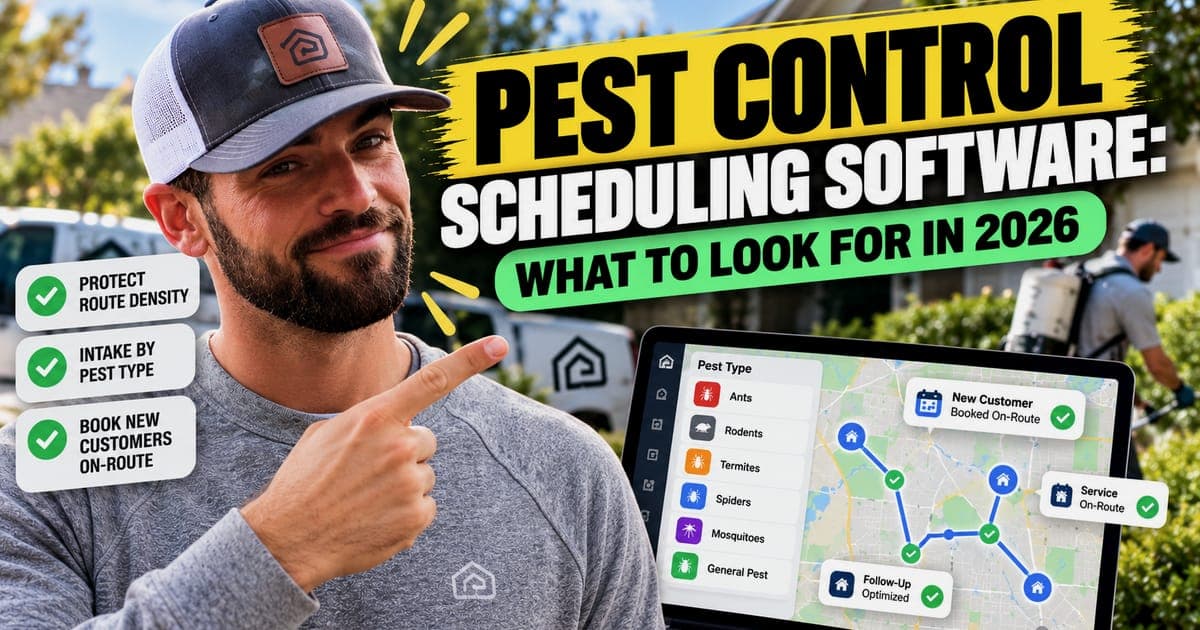
Drive-time-aware booking. Offered slots should account for where your techs already are, not only which hours are open. This is the single biggest lever on route density.
Branching intake by pest type. General pest, termite, rodent, bed bug, stinging insect, and mosquito each need different questions.
Variable durations by service. A quarterly exterior treatment and a termite inspection should not share a default time block.
Tech matching by license and skill. Fumigation, termite, and commercial work should only route to qualified techs.
After-hours booking by web and phone. Self-booking on your website plus a phone line that books, not just takes messages.
Automated confirmations with prep instructions. Bed bug and fumigation prep has to reach the homeowner days ahead.
Lead qualification at booking. Property ownership, service area, and one-time vs. recurring intent, captured before the visit.
Works with the system you already run. Your route software runs the recurring book. Your scheduling layer should feed it clean, well-placed customers, not replace it.
How Driive Works for Pest Control Companies
Driive is the scheduling layer that sits in front of the system that runs your routes. It handles the moment a new customer books.
When a homeowner books online or calls, the Driive Brain checks where your techs already are that day and offers the slots that keep routes tight. The north-suburbs ant customer gets offered Thursday afternoon, when a tech is already working two streets over, instead of Thursday at 10 when nobody is close.
Dot, Driive's booking agent, answers calls and texts after hours and books with the same rules. Dot does not guess or improvise. The scheduling rules live in the Driive Brain, so Dot books the way your best dispatcher would, at 10 p.m. on a Sunday, every time.
Branching booking forms capture pest-specific intake details. Confirmations and reminders go out automatically, with prep instructions for the services that need them.
DEV WARNING: REMOVE BEFORE PUBLISH
[VERIFY: Confirm which pest control platforms Driive integrates or syncs with today (PestPac, FieldRoutes, GorillaDesk, Jobber, ServiceTitan, Google/Outlook calendars). Replace this block with one sentence naming confirmed integrations, or remove it.]
Frequently Asked Questions
What is pest control scheduling software?
Pest control scheduling software books service appointments, assigns technicians, and manages recurring visits for pest control companies. The best tools also capture pest-specific intake details at booking and offer appointment times based on where technicians are already working, which protects route density on recurring plans.
Do I need to replace PestPac, FieldRoutes, or GorillaDesk to use Driive?
No. Driive is a scheduling layer, not a replacement for your pest control platform. Your existing system keeps running recurring routes, chemical tracking, and billing. Driive handles the first booking for new customers so they land on routes you already run.
How does drive time affect pest control profitability?
Recurring service makes up most residential pest control revenue, so every customer booked off-route costs extra drive time on every future visit. A quarterly customer 20 minutes off-route adds about 160 minutes of driving per year. Direct labor is the largest cost in pest control, and drive time is labor that produces no revenue.
What should a pest control booking form ask?
At minimum: the pest, where it was seen, property type and size, and whether the customer wants a one-time service or a recurring plan. Termite requests should capture real estate closing dates. Bed bug requests need room count and property type so prep instructions can go out before the visit.
Can pest control customers book online after hours?
Yes, with self-booking on your website and a booking agent that answers the phone. Most pest problems are discovered evenings and weekends. A company that books the customer at 10 p.m. wins a multi-year service plan before a competitor returns the call the next morning.
How should I schedule termite inspections for real estate closings?
Capture the closing date at booking and treat it as a hard deadline. Route the inspection to a tech licensed for wood-destroying insect work, and schedule early enough to allow time for a report and any required treatment before closing.
Sources
- National Pest Management Association. "U.S. Pest Control Industry Sustains Steady Growth with 6% Increase in 2025." Summary of Specialty Consultants' Strategic Analysis of the U.S. Structural Pest Control Industry. https://www.npmapestworld.org/your-business/latest-news/us-pest-control-industry-sustains-steady-growth-with-6-increase-in-2025/
- National Pest Management Association and PCO Bookkeepers & M&A Specialists. "2025 Pest Control Industry Cost Study." https://www.npmapestworld.org/your-business/latest-news/npma-and-pco-bookkeepers-release-comprehensive-2025-pest-control-industry-cost-study/
Continue exploring the contractor tech stack
- Back to the full buyer's guide
- Compare the best service scheduling software for home service businesses
- HVAC scheduling software: what to look for in 2026
- Plumbing scheduling software: emergency vs. routine booking
- Electrical contractor scheduling software
- How to reduce no-shows in a home service business
Book new customers where your routes already are.
Driive was built for trades where techs drive to the job, and pest control drives more than most.


